What every shift swap policy needs to be compliant

What every shift swap policy needs to be compliant
A compliant shift swap policy rests on five controls: genuine consent from both employees, manager approval before the swap goes ahead, a qualification check on the covering employee, an overtime and weekly-hours check, and a timestamped audit trail. Miss any one of these and you’re carrying legal and payroll risk you don’t need.
Your immediate action: require every swap request to go through your official scheduling channel for manager sign-off, and block any swap that would push either employee into overtime. Fair Work treats roster changes as something that needs genuine agreement and proper records, not a text message between two staff members.
- Consent — both employees confirm in writing or in-system
- Approval — a manager signs off before the swap is live
- Qualification check — the covering employee can legally and safely do the shift
- Hours check — the swap doesn’t trigger unplanned overtime
- Audit trail — timestamped record of the request, approval and outcome
Tools like CaterFlow AI and general scheduling platforms such as Microsoft Teams’ shift management build these checks into the request process itself, so nothing slips through on a busy Friday.
Key Takeaways
A compliant shift swap policy works because it pairs genuine consent and manager approval with automated overtime and qualification checks, backed by a timestamped audit trail.
| Point | Details |
|---|---|
| Five non-negotiable controls | Consent, manager approval, qualification checks, hours checks, and a documented audit trail. |
| Notice periods should vary by shift type | Use 24–72 hours for standard shifts, longer for specialist or peak roles. |
| Overtime must be checked before approval | Swaps that push either employee over standard hours risk unplanned overtime costs. |
| Cap swap frequency | Limiting swaps to 2–5 per month prevents roster gaming and signals which staff need schedule changes. |
| Automation closes enforcement gaps | Platforms like CaterFlow AI apply your swap rules automatically, flagging qualification and overtime issues before a manager approves. |
Table of Contents
- Why your business needs a formal shift swap policy
- Compliance and legal checks your policy must include
- Core policy elements: eligibility, notice, approvals and limits
- The step-by-step workflow for requesting and approving swaps
- Using scheduling software to enforce the rules automatically
- A sample shift swap policy you can adapt
- Rolling out your policy in the first 90 days
- What ten years of rostering headaches taught me
- Let automation handle your swap approvals and audit trail
- Sources
Why your business needs a formal shift swap policy
Without written rules, shift swaps happen by text message, sticky note, or a quiet word at the end of a shift. That works fine until it doesn’t. A no-show because “I thought Dave was covering me” costs you more than the missed shift. It costs you a scramble to find cover, a possible service failure, and an awkward conversation about who’s actually accountable.
Uncontrolled swaps also create payroll problems you won’t notice until the pay run. An employee who picks up an extra shift on top of their usual roster can tip into overtime without anyone flagging it, and by the time finance catches it, you’re already exposed.
There’s a fairness dimension too. When swap approval feels arbitrary, staff notice. Two employees ask for the same kind of swap and get different answers, and grievances follow. A written policy applied the same way every time removes that friction:
- Clear rules reduce disputes over who “actually” agreed to a swap
- Consistent approval criteria protect you from favouritism claims
- Documented processes make it obvious who was responsible for a shift if something goes wrong
- Predictable rules build trust, which matters more than most managers admit
Compliance and legal checks your policy must include
A shift swap policy isn’t just an internal admin document. It sits inside your obligations under workplace law, and getting the compliance detail wrong can expose you to underpayment claims or record-keeping breaches.
Genuine consent and consultation. Fair Work requires genuine consent for roster changes, along with proper consultation and record-keeping. A swap arranged verbally between two employees doesn’t meet that bar on its own. Your policy needs a documented consent step, even if it’s as simple as both parties confirming through your scheduling system.
Overtime and award interactions. This is where most informal swap arrangements fall over. Private employers must count the hours actually worked in a workweek when calculating overtime, according to labour-law guidance on shift swap policies — you can’t simply treat a swap as a like-for-like substitution and ignore the actual hours worked. If an employee picks up a shift that pushes their week past standard hours, overtime or penalty rates may apply regardless of what the roster originally said. Awards with different penalty rates for different shift types (weekends, nights, public holidays) add another layer. A swap that looks neutral on paper can quietly change what someone’s owed.
Record-keeping. Keep a timestamped record of the request, both employees’ confirmations, the manager’s approval, and any resulting change to hours or pay. Retain these for at least as long as your general employment record obligations require.
Practical checks to run before approving any swap:
- Does the covering employee hold the right qualifications, certifications or induction for the role?
- Will the swap push either employee over their standard weekly hours?
- Does the swap fall inside a blackout period (public holidays, peak events, mandatory training days)?
- Has the swap been documented with a timestamp and both employees’ sign-off?
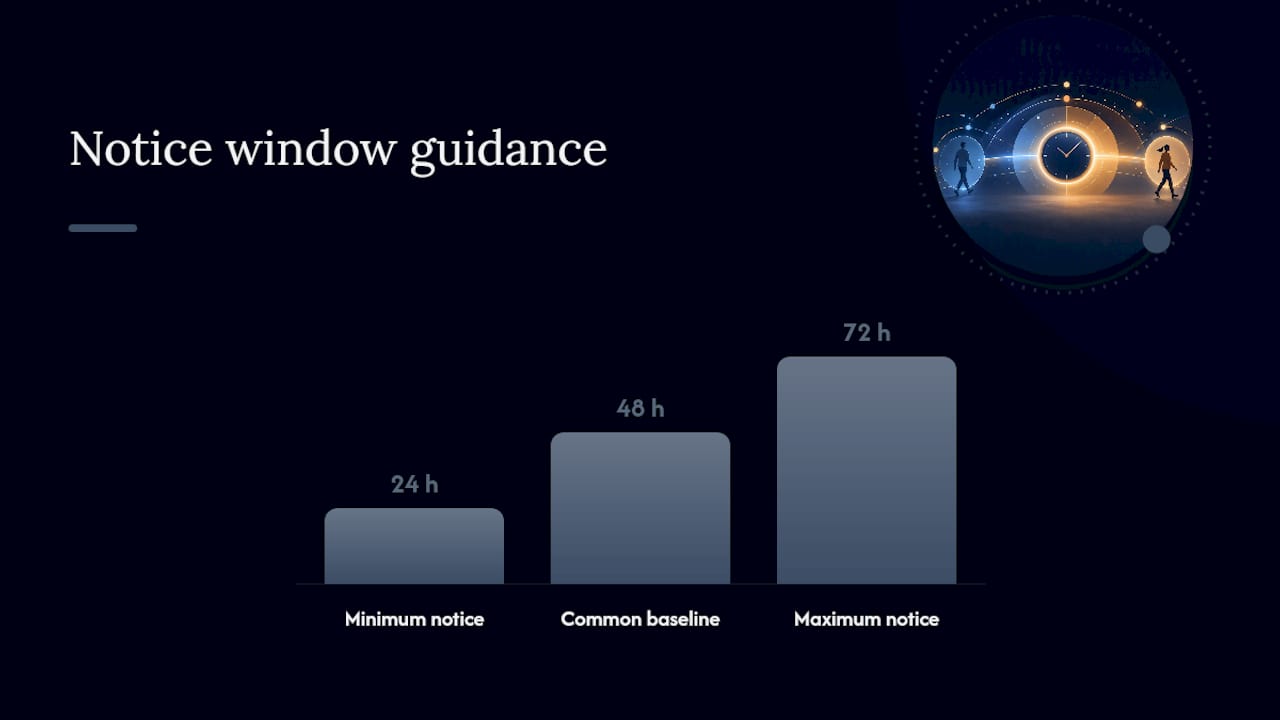
Roughly a 24 to 72 hour notice window is standard practice across most industries, with 48 hours the common baseline for ordinary shifts. That window gives you time to run these checks properly instead of approving under pressure five minutes before a shift starts.
Core policy elements: eligibility, notice, approvals and limits
The clauses below are the backbone of any shift swap policy. Adapt the specific numbers to your award and roster complexity, but keep the structure.
-
Eligibility. Define who can swap with whom. A barista can usually swap with another barista, but not with a chef, and a certified food handler can’t swap into a role requiring a certification they don’t hold. Spell this out by role, not by assumption.
-
Notice period. Set a minimum notice window for swap requests, typically 24 to 72 hours. Standard shifts can sit at the lower end; specialist roles, events with fixed staffing ratios, or peak trading periods deserve a longer window, sometimes a week out. Running one blanket rule for every shift type is simpler to write but harder to actually manage.
-
Approval authority and response time. Name who approves swaps (usually a shift supervisor or rostering manager) and set a service-level expectation for how fast they respond, such as within 24 hours of a request. Approval should never be assumed just because the covering employee agreed.
-
Overtime and weekly-hours checks. Require an automatic or manual check of both employees’ weekly hours before approval. Any swap that would create overtime for either party should be flagged and, in most cases, denied outright unless a manager specifically authorises the extra cost.
-
Blackout periods and swap caps. Identify dates where swaps aren’t permitted at all (major events, end-of-financial-year, public holidays with fixed staffing needs). Cap how many swaps an employee can make in a given period. A limit of two to five swaps per month is common practice and stops the roster turning into a moving target.
-
Accountability. State plainly that until a swap is approved, the originally rostered employee remains responsible for the shift. A no-show blamed on an unapproved swap is still a no-show on the original employee’s record.
Pro Tip: Write your notice-period rule as a range tied to shift type, not a single number. “48 hours for standard shifts, 7 days for events over 50 guests” is far easier to enforce than a one-size-fits-all rule that gets exceptions every second week.
The step-by-step workflow for requesting and approving swaps
A consistent process is what turns your written policy into something staff actually follow. Here’s the sequence that works across most rostering setups:
- Employee submits the request. The employee initiating the swap logs it through your official scheduling channel, naming the covering employee and the shift in question.
- Covering employee confirms. The second employee must actively confirm acceptance in the system. Silence or a casual verbal “yeah sure” isn’t a confirmation.
- Automated checks run. Before it reaches a manager, the system (or the manager manually) checks the covering employee’s qualifications, current weekly hours, and any blackout restrictions.
- Manager reviews and approves or denies. The manager weighs staffing impact for the shift in question, not just whether the paperwork checks out, then approves or rejects within the agreed response time.
- Payroll and timesheets update. Once approved, the swap must be reflected in the actual timesheet, not just the roster. This is where a lot of businesses lose track and pay the wrong person for the wrong shift.
Until step 4 is complete, the originally rostered employee stays responsible for the shift. That single rule resolves more disputes than any other clause in the policy.
| Point | Details |
|---|---|
| Consent isn’t optional | Both employees must actively confirm the swap, not just imply agreement. |
| Manager approval is the gate | No swap is live until a manager has checked and signed off. |
| Payroll must reflect reality | Timesheets need updating after approval, not left to match the original roster. |
Using scheduling software to enforce the rules automatically
Manual approval processes fail in predictable ways: a manager forgets to check overtime, a qualification gets missed, or a swap gets approved by text and never makes it into the system at all. Automation closes those gaps.
The features that matter most are overtime blocking (the system won’t let a swap go through if it breaches weekly hours), qualification flags (it checks the covering employee actually holds the right certification or role experience), a single audit trail, and real-time schedule updates that both employees and payroll can see immediately. Digital scheduling systems with these checks built in cut down on the errors that come from fragmented, ad hoc communication across texts, group chats and paper rosters.

The operational payoff is straightforward: fewer no-shows because responsibility is always clear, faster approvals because managers aren’t manually cross-checking hours, and fewer payroll errors because the system, not a spreadsheet, tracks what actually happened.
Automation still needs a manager override for genuine exceptions, an employee filling in during a sudden staff shortage, for example. Log every override with a reason, so your audit trail stays complete even when the rules bend.
Pro Tip: If your current system requires a manager to manually check three separate spreadsheets before approving a swap, that’s not a policy problem, it’s a tooling problem. Fix the tool before you rewrite the policy again.
A sample shift swap policy you can adapt
Use this structure as a starting template and adjust the specific numbers for your award coverage and roster complexity.
- Scope — which roles and shift types this policy covers
- Eligibility — swaps permitted only between staff with matching qualifications
- Request process — submitted through the official scheduling channel, never verbally
- Notice period — minimum 48 hours for standard shifts, 7 days for peak periods
- Approval — manager sign-off required within 24 hours of request
- Overtime rule — swaps creating overtime are denied unless separately authorised
- Record-keeping — timestamped log of request, confirmation and approval retained per employment record requirements
- Blackout dates — no swaps permitted during listed peak periods
- Consequences — unapproved swaps treated as a no-show against the original rostered employee
| Element | Suggested value | Adjust for |
|---|---|---|
| Notice period, standard shifts | 48 hours | Casual vs permanent staff, award terms |
| Notice period, specialist or peak shifts | 7 days | Events, certified roles, public holidays |
| Swap cap per employee | 2–5 per month | Roster complexity, team size |
Template guidance from 7shifts converges on this same manager-approval-plus-documentation model, which makes it a safe structural starting point regardless of your industry.
Rolling out your policy in the first 90 days
- Weeks 1 to 2: Finalise the written policy, configure your scheduling software’s overtime and qualification rules, and publish the document in your staff handbook.
- Weeks 3 to 4: Run a short training session with supervisors on approval criteria and response-time expectations.
- Days 30 to 60: Pilot the process, monitor no-show rates, unauthorised swap attempts, and average approval time.
- Day 90: Review the data against your original baseline and adjust notice periods, swap caps or approval authority as needed.
Set a simple monitoring cadence from day one, weekly for the first month, then monthly, so problems surface before they become patterns.
What ten years of rostering headaches taught me
I’ve seen two versions of the same mistake play out constantly. One venue let staff swap shifts by group chat, and a covering employee without food handling certification ended up on a line they weren’t qualified for. Another had a manager approve a swap verbally, then forget to update the timesheet, and the wrong person got paid for a shift they didn’t work.
Both problems trace back to the same gap: no single channel, no forced approval step. The moment a business moves every swap request through one system with mandatory manager sign-off, these issues mostly disappear. It’s not a complicated fix. It’s a discipline problem, and software like CaterFlow AI exists precisely because manual discipline is hard to sustain when you’re short-staffed on a Saturday night.
Let automation handle your swap approvals and audit trail
Writing the policy is half the job. Enforcing it every single shift, without a manager manually cross-checking hours and qualifications each time, is where most businesses quietly slip. CaterFlow AI is built specifically for catering operators, and it applies your swap rules automatically instead of leaving them to memory.
It flags qualification mismatches, blocks swaps that would trigger overtime, and keeps a timestamped record of every request and approval so you’re never relying on a text thread to prove what happened. It also folds into the same back-of-house automation catering businesses already use for quoting, invoicing and onboarding, so your rostering rules sit inside the same system as everything else, rather than as a separate spreadsheet nobody updates. If you’re ready to see how it handles your actual roster, book a CaterFlow AI demo and bring your current swap headaches with you.
Sources
- Fair Work Ombudsman
- Shift swap policy for Fair Work compliance in Australia — RosterElf
- Staffapp
- Shift swap policy template — 7shifts