Recover unpaid invoices: a practical escalation plan

Recover unpaid invoices: a practical escalation plan
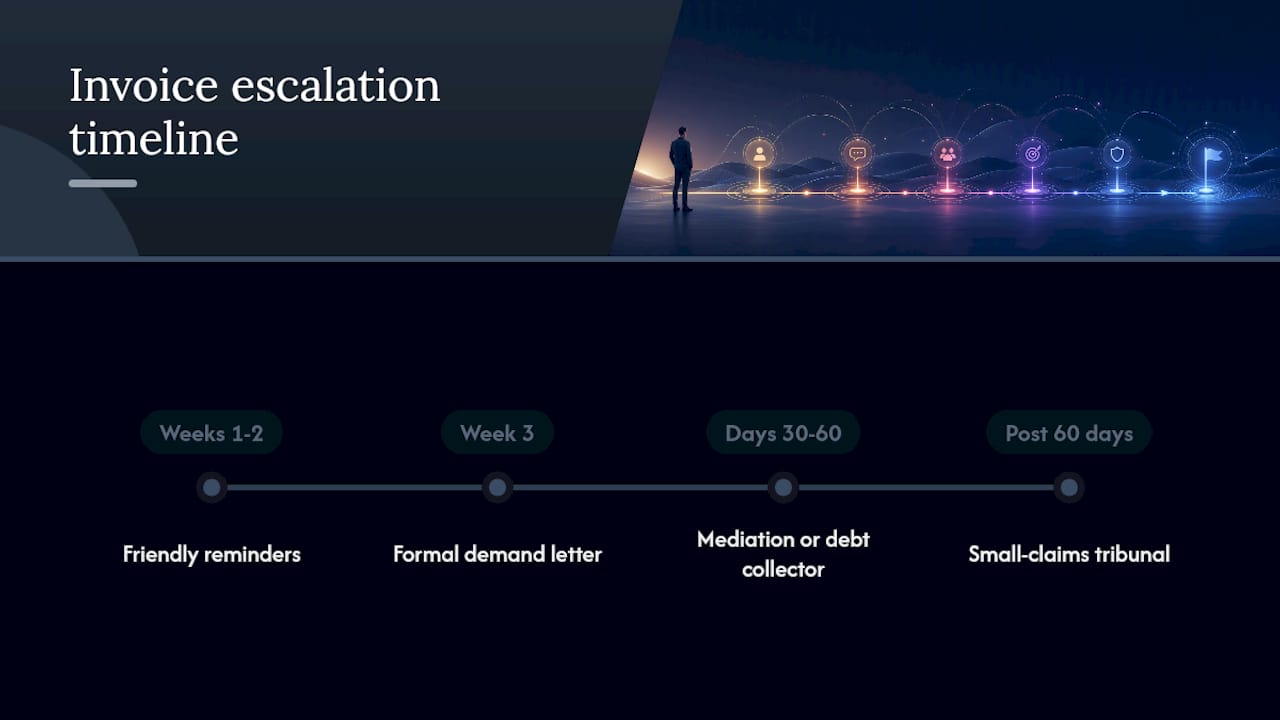
The fastest way to recover unpaid invoices is a predictable four-step escalation: friendly reminder, then a formal letter of demand, then dispute resolution or a debt collector, then a small-claims tribunal if nothing else works. Each step has a rough window: reminders in the first two weeks, a demand letter by week three, mediation or collection by day 30 to 60, and legal action only once you’ve weighed the cost against the debt itself.
Before you send anything, build a quick file: invoice ID, the contract clause covering payment terms, dates of every contact, your next deadline, and the escalation action you’ll take if it passes. Keep that file updated every time you speak to the client.
Pro Tip: If the invoice is for a small amount, the tribunal filing fee and your time chasing it might cost more than you recover. Weigh the debt against the effort before you escalate past a phone call.
Key Takeaways
Recovering unpaid invoices works best as a fixed, staged sequence, escalating from reminders to demand letters to mediation or a tribunal only when each prior step has genuinely failed.
| Point | Details |
|---|---|
| Contact early | Invoices chased within the first week of becoming overdue recover at much higher rates than those left until day 30. |
| Use phone calls sooner | Phone calls get responses 4 to 6 times faster than email, so escalate to a call within the first week. |
| Document everything | Keep signed contracts, delivery proof, and a dated communication log ready before you escalate further. |
| Weigh the cost before litigating | Tribunal claims carry filing fees that can exceed small debts. |
| Automate the cadence | Caterflowai runs reminder and escalation sequences automatically and syncs with Xero, QuickBooks, and MYOB, saving catering businesses 10+ hours a week. |
Table of Contents
- Review your contract and invoice records before you recover unpaid invoices
- Send friendly reminders at the right time
- How do you write a formal letter of demand?
- Should you try mediation before legal action?
- Is a debt collector or debtor finance worth the fee?
- When should you take legal action to recover unpaid invoices?
- Negotiating a settlement or payment plan
- Protecting your business from future unpaid invoices
- Why systemising your escalation path recovers more cash
- A small business owner’s take on chasing unpaid invoices
- How automation turns your escalation plan into a routine
- Sources
Review your contract and invoice records before you recover unpaid invoices
Before you chase anyone, check what you can actually enforce. Small-business guidance recommends reviewing your written agreement, including any terms accepted online, before you contact the client.
Gather these documents:
- Signed contract or terms of trade (even an email acceptance counts)
- The original invoice with a clear due date
- Proof of delivery or completion, such as a signed delivery note or event sign-off
- Any change orders, variations, or approvals that adjusted the original scope
- Purchase order numbers and prior payment receipts
Each one proves you delivered what was agreed, which matters enormously if the client disputes the amount later.
Pro Tip: Keep a dated log of every call and email, and save full email headers and attachments. A demand letter or tribunal claim is only as strong as the paper trail behind it.
Send friendly reminders at the right time
Timing beats tone here. A three-touch reminder sequence works well: a note when you send the invoice, a reminder a few days before it’s due, and a firm follow-up the day after it lapses. From there, escalate to a phone call within the first week, because contacting a debtor early sharply improves your odds of getting paid.
Three templates worth keeping on hand:
- Email: “Hi [name], just a friendly reminder that invoice #[number] for $[amount] was due on [date]. Let us know if you need a copy or have any questions.”
- Phone script: “Hi [name], I’m calling about invoice #[number], which was due on [date]. Is there anything holding up payment on your end?”
- SMS: “Hi [name], invoice #[number] ($[amount]) is now overdue. Can you give us a call to sort it out?”
CC your client’s accounts-payable inbox, attach the original invoice PDF, and always state the invoice number and due date plainly.
Phone calls typically get a response 4 to 6 times faster than email, because a live conversation forces real-time accountability that a silent inbox never will.
How do you write a formal letter of demand?
Send a letter of demand once polite reminders have gone unanswered and you need to show a clear, documented escalation. This is the point where tone shifts from friendly to formal, and it should read that way.
Include:
- Full account history and every invoice reference involved
- Any contract clause covering late fees or interest
- The total owing, including allowable fees
- A firm payment deadline (commonly 7 to 14 days)
- The consequences of non-payment, stated plainly
A short sample you can adapt:
If the invoice is unusually large, disputed, or the client has gone quiet entirely, it’s worth having a lawyer draft or review the letter rather than sending a template unchecked.
Pro Tip: A demand letter that includes a proposed payment plan template alongside the deadline often gets a faster reply than one that only threatens action.
Should you try mediation before legal action?
Mediation is almost always cheaper and faster than court, and it makes the most sense when you still want to work with the client, the goods or services are disputed, or legal fees would swallow whatever you’d recover. The Australian Small Business and Family Enterprise Ombudsman runs a dispute support service and a mediator panel specifically for small businesses trying to resolve payment issues without going to court.
Your options include:
- Free or low-cost government-run mediation services
- Small-business commissioners in your state
- Private commercial mediators for larger or more complex disputes
- Industry-specific ombudsmen where they exist
Pro Tip: Any agreement reached in mediation, whether it’s a payment plan or a reduced settlement, should be put in writing with clear consequences if the debtor defaults again.
Is a debt collector or debtor finance worth the fee?
Once internal follow-up stalls, you’re choosing between three paths: a traditional collection agency, a contingent-fee collector, or debtor finance where you sell the invoice for immediate cash at a discount. Business Queensland notes that all three recover cash faster than you likely could alone, but each takes a cut of what you’re owed.
Before choosing a collector, check:
- Whether they follow the ACCC’s debt collection guidelines, which set minimum standards for fair conduct
- Their fee structure, especially whether it’s a flat percentage or tiered by debt age
- References from other small businesses in your industry
- How often they report back to you and in what detail
Collections tend to work best on invoices over 60 days old from unresponsive clients. For invoices under a few hundred dollars, or clients you plan to keep working with, the fee and relationship damage usually aren’t worth it.
When should you take legal action to recover unpaid invoices?
If mediation and collection efforts fail, a small-claims tribunal is usually your next move rather than full court proceedings. In Queensland, QCAT handles minor debt disputes within a capped amount, and filing fees are modest compared to district or supreme court costs. Equivalent tribunals exist in every state, generally without requiring legal representation.
Run this cost/benefit check before filing:
- Estimate the filing fee, your time, and any legal costs against the amount owed
- Confirm the debtor is still trading and has recoverable assets, since a judgment against an empty company is worthless
- Make sure you’ve preserved every reminder, letter, and response as evidence
Pro Tip: If the debt is close to the tribunal’s monetary limit, check whether splitting it into separate claims is even allowed. Some tribunals won’t let you artificially divide a single debt to fit under the cap.
Negotiating a settlement or payment plan
Sometimes the smartest move is accepting less than the full amount, faster, over insisting on everything and waiting months. A basic payment plan should specify the instalment dates, amounts, any late fee or interest, and what happens if a payment is missed.
Use this to decide your next move:
- If cash flow is tight now, a partial payment today may beat a full payment in three months.
- If the client has a track record of paying eventually, a structured plan preserves the relationship better than escalation.
- If they’ve missed previous promises, insist on security, such as a deposit or a personal guarantee, before agreeing to anything.
Whatever you agree to, put it in writing and get it signed before work or supply resumes.
Protecting your business from future unpaid invoices
Prevention beats recovery every time. Clear terms of trade, deposits or milestone payments on larger jobs, PO numbers on every invoice, and a final accuracy check before sending all reduce disputes before they start.

Run reminders automatically at these points: before the due date, on the due date, and again at 7, 30, 60, and 90 days overdue. Structured accounts receivable ageing helps you spot which invoices need attention first, instead of chasing ones that are already close to being paid.
Add contract clauses for late fees and, where appropriate, the right to suspend future work until an account is current.
Pro Tip: Automated reminders remove the awkwardness of chasing clients yourself, and they mean no overdue invoice slips through simply because you got busy with a job.
Why systemising your escalation path recovers more cash
Recovery success comes down to speed and consistency, not persistence alone. Invoices contacted within the first week of becoming overdue recover at a far higher rate than those first chased at the 30-day mark, and the probability of collecting drops sharply once a debt passes roughly 90 days overdue, which is why many businesses treat anything older as bad debt.
A workable escalation timeline looks like this: day 1 automated email, day 3 phone call, day 7 firm written notice, day 14 formal demand letter, day 30 consider a collector or mediator.

Scheduled, automated follow-up sequences consistently recover more money than ad hoc chasing, largely because they remove the delay caused by someone simply forgetting to follow up.
A small business owner’s take on chasing unpaid invoices
Chasing money you’re owed feels personal, but it shouldn’t be. The businesses that recover fastest are the ones with a plan already written before the invoice even goes out, not the ones improvising a script while frustrated on the phone. Removing the emotion from collections is what actually protects your cash flow and your client relationships.
How automation turns your escalation plan into a routine
Chasing overdue invoices manually is one of the most time-consuming parts of running a catering business, and it’s exactly the kind of repetitive task that automation handles better than a busy owner squeezing it in between events.

Caterflowai runs the reminder cadence for you automatically, from the pre-due nudge through to the day-30 escalation notice, and keeps every email, call note, and payment status in one place instead of scattered across inboxes and spreadsheets. It integrates directly with Xero, QuickBooks, and MYOB, so your accounts stay current without double entry, and catering business owners using it report saving 10 or more hours a week on admin they used to do by hand. Instead of building your own escalation sequence from scratch, Caterflowai sets it up for you against the timeline outlined above. You can start with a free audit of your current invoicing setup and see exactly where overdue payments are slipping through before you commit to anything.
Sources
Check these when you’re filing a claim, vetting a collector, or looking for a mediator: