What a fair catering cancellation policy actually says

What a fair catering cancellation policy actually says
A reasonable catering cancellation policy pays out on a sliding scale: full or near-full refunds when you cancel 30 days or more before the event, dropping sharply from around 14 days out, and little to nothing inside 48 to 24 hours. Deposits are almost always non-refundable once they’ve secured your date, and most policies carve out separate rules for rescheduling and force majeure events like extreme weather or government restrictions. Understand those three levers, timeline, deposit, and exceptions, and you can read any catering agreement in about two minutes.
TL;DR:
- Refund percentages decline sharply within the last week before the event, often reaching zero inside 24 hours due to committed costs.
- Deposits are typically non-refundable upon signing, with full payments required a week before and late payments risking cancellation.
- Final headcounts are usually locked 5 to 7 days prior, and late adjustments often result in additional charges or no change in billing.
- Force majeure events like severe weather or government restrictions may trigger full refunds or free rescheduling with proper documentation.
- Automating cancellation and payment follow-up can significantly improve recovery of overdue funds and reduce administrative workload.
Table of Contents
- Cancellation policy catering timelines and typical refund bands
- Deposits, final payments and headcount rules
- How refunds are calculated and processed
- Rescheduling, postponements and force majeure: what to expect
- Checklist and model clauses for a booking confirmation
- How automation helps caterers manage cancellations and recover payments
- Legal considerations and consumer rights in catering cancellations
- Negotiating exceptions to a standard cancellation policy
- Communicating cancellation terms clearly to clients
- What cancellations mean for vendor relationships and future bookings
- Practitioner perspective: why transparent policies protect both parties
- Automate the admin around every cancellation with CaterFlow AI
- Sources
Cancellation policy catering timelines and typical refund bands
Every catering cancellation policy is really just a countdown clock. The further out you cancel, the more of your money comes back, because the caterer hasn’t yet spent it on produce, staff rosters, or hired equipment.
Most Australian catering businesses structure their bands around similar milestones, even if the exact percentages shift slightly from supplier to supplier. CaterKin’s published policy, for example, offers a full refund for cancellations 7 or more days out, 50% for 3 to 7 days, 25% for 1 to 3 days, and no refund inside 24 hours.
The operational logic is straightforward. A caterer cancelling an order with a wholesaler 30 days out loses nothing. Cancelling 48 hours out after fresh produce has been ordered and casual staff booked means the business absorbs real costs, which is why refunds shrink fast in that final week.
Typical bands look like this:
- 30+ days before the event: Full or near-full refund, minus the deposit in most cases.
- Within about two to four weeks before: Partial refund.
- Shorter notice periods: Reduced refund.
- Inside 24 hours: No refund at all in almost every policy reviewed.
| Notice given | Typical refund | Why |
|---|---|---|
| 30+ days | Mostly full refund | No costs committed yet |
| Within a few weeks before | Partial refund | Menu planning underway |
| Shorter notice | Reduced refund | Produce and staff being locked in |
| Just days before | Minimal refund | Orders placed, staff rostered |
| Under 24 hours | No refund | Costs fully committed |
Nosh Catering’s refund policy explains this plainly: full payment is due 7 days before the event, and refunds shrink from that point because procurement and staff scheduling are already locked in.
Deposits, final payments and headcount rules
A deposit isn’t a down payment you can walk away from. It’s the fee that takes your date off the market, and most catering agreements treat it as forfeited the moment you sign, regardless of what happens next.
Deposits typically represent a sizeable portion of the overall fee across most Australian caterers, with the balance due closer to the event. Nosh Catering requires full payment about a week before the event, a common enough standard that you should treat any policy asking for less notice as unusually flexible, and any asking for more as unusually strict.
Late final payment carries its own consequences, separate from cancellation. Miss the deadline and many caterers reserve the right to treat the booking as cancelled outright, triggering whatever refund band applies at that point on the calendar.
Headcount rules deserve just as much attention as the dollar figures:
- Final guest numbers are usually locked in 5 to 7 days before the event.
- Reducing numbers after that point rarely reduces your bill, because food and staff are already ordered against the higher count.
- Increasing numbers late is often accommodated, but sometimes at a premium rate.
- Some contracts specify a minimum guaranteed headcount you’ll be billed for regardless of who actually shows up.
Pro Tip: Ask for the headcount deadline in writing before you sign, not just the cancellation terms. It’s the date most disputes actually trace back to, not the cancellation clause itself.
How refunds are calculated and processed
Refunds aren’t a simple percentage of the total invoice. Caterers typically deduct costs already committed, then refund what’s left.
Common deductions include the cost of perishable food already purchased, wages for casual staff already rostered, equipment or linen hire that can’t be cancelled without penalty, and payment processing fees the caterer itself can’t recover. Stack those against your cancellation date and you get the real refund figure, not the headline percentage in the policy.
Processing time is the part most people forget to ask about. Ozzie’s Catering’s refund policy lists an approximate one to two week turnaround for approved refunds, a window echoed across most suppliers in the sector.
A full refund is realistic only in two scenarios: cancelling well outside the top timeline band, or invoking a force majeure clause.
Rescheduling, postponements and force majeure: what to expect
Postponing isn’t the same as cancelling, and the two get treated very differently in most agreements. A reschedule requested early enough usually lets your deposit transfer to the new date at no extra cost.
Soul Mamas Catering’s terms reflect a common structure: reschedules requested with roughly 30 days’ notice transfer cleanly, while requests made closer to the date get treated as a straight cancellation instead, with whatever refund band applies at that point.
Force majeure clauses cover the events genuinely outside anyone’s control:
- Government-mandated restrictions or lockdowns preventing the event from proceeding.
- Severe weather that makes the venue or delivery unsafe.
- Natural disasters, including floods, fires, or similar declared emergencies.
The BBQ Catering Company’s terms treat these triggers as grounds for a full refund or a free reschedule, rather than applying the standard sliding scale. The catch is documentation. Providers generally expect evidence, a government notice, an official weather warning, before waiving fees that would otherwise apply.
Checklist and model clauses for a booking confirmation
A booking confirmation that skips these eight items is asking for a dispute later. Work through them in order, and you’ll cover the ground that actually matters.
- Notice method. State how cancellation must be communicated. “Cancellations must be submitted in writing via email to be considered valid.”
- Timeline bands. Set the refund percentage at each notice period. “Cancellations made 30 or more days prior receive a full refund less the deposit.”
- Deposit terms. Confirm non-refundability upfront. “A 30% deposit is required to secure your date and is non-refundable.”
- Final payment deadline. Name the exact date. “Full payment is due 7 days before the event date.”
- Headcount deadline. Lock in numbers with a clear cutoff. “Final guest numbers must be confirmed 5 business days prior and are the minimum billable count.”
- Refund timing. Set expectations on processing. “Approved refunds are processed within 5 to 10 business days.”
- Force majeure. Define what qualifies. “Full refunds or free rescheduling apply where government restrictions or severe weather prevent the event proceeding.”
- Provider cancellation. Cover the reverse scenario. “Should the caterer need to cancel, a full refund will be issued within 5 business days.”
Pro Tip: Treat vague wording like “refunds at management’s discretion” as a red flag. A policy without numbers isn’t a policy, it’s a negotiation waiting to happen at the worst possible time.
How automation helps caterers manage cancellations and recover payments
Chasing a client for a cancellation fee by phone is awkward, and it’s the kind of admin that eats an evening you don’t have. Automation handles the parts of this process that don’t need a human touch: sending payment reminders before the final deadline, generating the invoice adjustment the moment a cancellation is logged, and keeping a clean record of what was refunded and when.

Faster follow-up matters more than it sounds. A reminder sent the day a deadline passes recovers money far more reliably than one sent a week later, once a client has mentally moved on. CaterFlow AI clients report recovering meaningful amounts from overdue invoices through automated follow-ups, alongside genuine time saved on administration each week.
What this actually replaces:
- Manual tracking of who owes what after a cancellation or reschedule.
- Chasing overdue balances by phone or awkward email.
- Rebuilding invoices by hand every time a headcount changes.
Legal considerations and consumer rights in catering cancellations
Catering contracts don’t operate in a vacuum. In Australia, consumer protections apply on top of whatever a supplier’s written terms say, and a policy that contradicts them isn’t enforceable just because a client signed it.
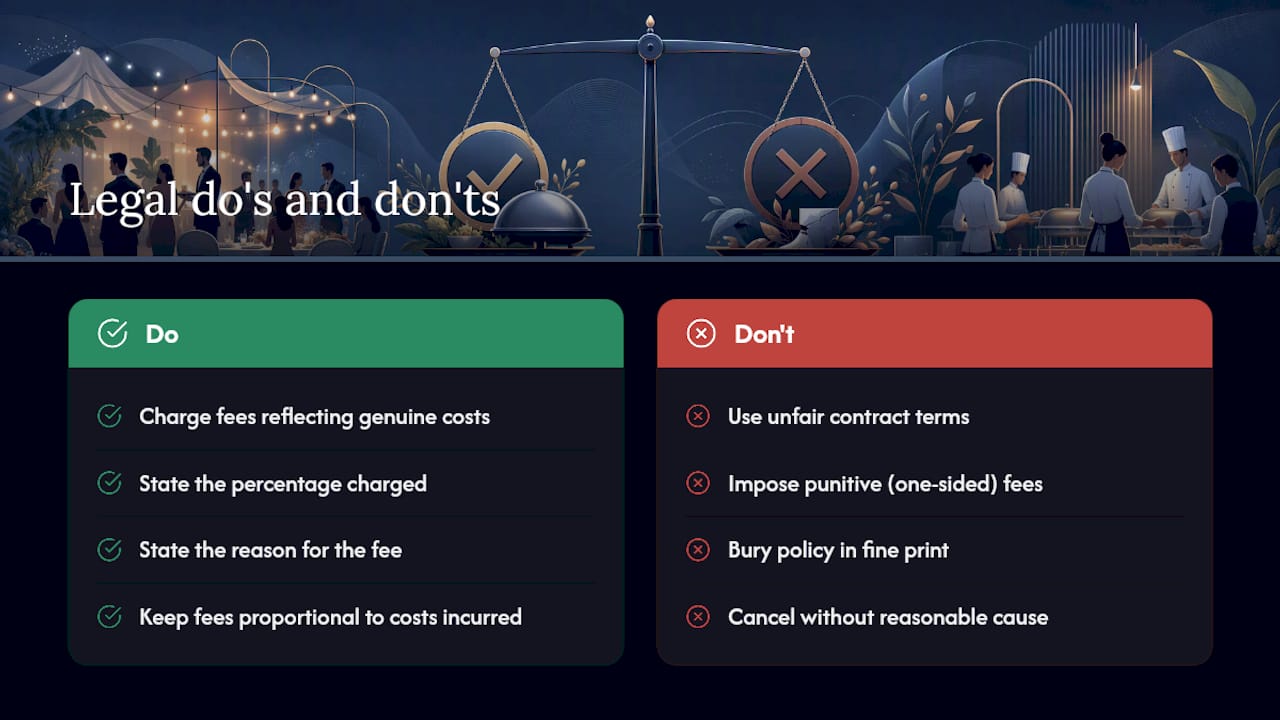
Under Australian Consumer Law, businesses can’t rely on unfair contract terms, clauses that impose a one-sided or disproportionate penalty on the consumer while giving the business an easy exit.
Consumers also retain rights around services not delivered as described. If a caterer fails to show, delivers well below the agreed standard, or cancels without reasonable cause, the client is generally entitled to a remedy under consumer law regardless of what the fine print says about the caterer’s own liability.
None of this means caterers can’t charge cancellation fees. A fee that reflects genuine costs already incurred, produce, staff, hire equipment, is standard practice and broadly defensible. The line gets crossed when a fee is punitive rather than compensatory, or when a policy is buried in terms nobody reasonably reads before signing.
For businesses drafting these policies, the safest position is transparency: state the percentage, state the reason, and keep it proportional to what’s actually been spent by that point in the timeline.
Negotiating exceptions to a standard cancellation policy
Most catering cancellation policies aren’t as rigid as they read on the page. The written percentage is the default position, not always the final word, and caterers who’ve been in business for a while generally have a process for handling genuine exceptions.
The strongest cases for negotiation involve documentation: a medical emergency, a genuine bereavement, or a venue-side cancellation outside your control. Bring evidence rather than just asking for goodwill, and ask early rather than after the refund has already been processed under standard terms.
Timing your request matters as much as the reason behind it. Asking for flexibility the moment circumstances change, rather than waiting until days before the event, gives a caterer more room to reallocate produce orders or offer the date to another client.
A few approaches tend to work better than others:
- Ask for a partial concession rather than a full waiver, since caterers are more willing to meet in the middle than grant a total exception.
- Offer to reschedule instead of cancel outright, which protects the caterer’s revenue while solving your problem.
- Request the exception in writing, and get any agreed change confirmed the same way.
What rarely works is asking after the fact, once a cancellation has already gone through standard processing, expecting a retroactive policy change.
Communicating cancellation terms clearly to clients
The best cancellation policies aren’t the strictest ones. They’re the ones nobody misreads. A short, well-structured timeline table and a plain-language summary do more to prevent disputes than three pages of legal wording buried in an appendix.
Put the refund bands in the booking confirmation itself, not just the standalone terms document a client might never open. State the deposit percentage and its non-refundable status in the same paragraph where you state the deposit amount, so there’s no gap between what a client pays and what they understand they’re agreeing to.
Verbal confirmation backs up written terms without replacing them. A quick line during the booking call, “just so you know, the deposit locks in the date and isn’t refundable, does that work for you?”, catches confusion before it becomes a dispute months later.
Model your policy less on a legal disclaimer and more on a clear, well-structured proposal template: specific numbers, specific dates, and nothing left to interpretation. Clients who understand the terms at booking rarely fight them at cancellation, because there’s nothing to argue about.
What cancellations mean for vendor relationships and future bookings
A single cancellation, handled well by both sides, rarely damages a business relationship. A cancellation handled badly, vague communication, a refund that never arrives, a fee that feels punitive, tends to end the relationship entirely and often turns into a public review.
Clients who cancel and get treated fairly, even when the refund is partial, frequently rebook for future events. The policy did its job: it protected the caterer’s costs while still respecting the client. That’s the outcome worth designing for, not maximum fee recovery on any single cancellation.
The reverse is just as true for caterers. A business that waives fees inconsistently, generous with one client, rigid with another for the same circumstances, damages its own credibility faster than any single cancelled booking ever could. Consistency, backed by clear written exceptions criteria, protects the business’s reputation more than the fee itself ever will.
Practitioner perspective: why transparent policies protect both parties
Rigid cancellation policies feel safer on paper, but they’re not actually where most caterers land once they’ve been through a few genuine emergencies. The businesses that avoid disputes keep a documented, case-by-case exception path, applied consistently, rather than a fixed rule with no flexibility. Clear written terms plus a fair process for genuine hardship protect the business financially and reputationally at the same time, which a strict policy alone never manages.
— Tim
Automate the admin around every cancellation with CaterFlow AI
Chasing overdue balances and rewriting invoices by hand after every cancellation or headcount change is exactly the kind of work that shouldn’t need a person doing it manually.
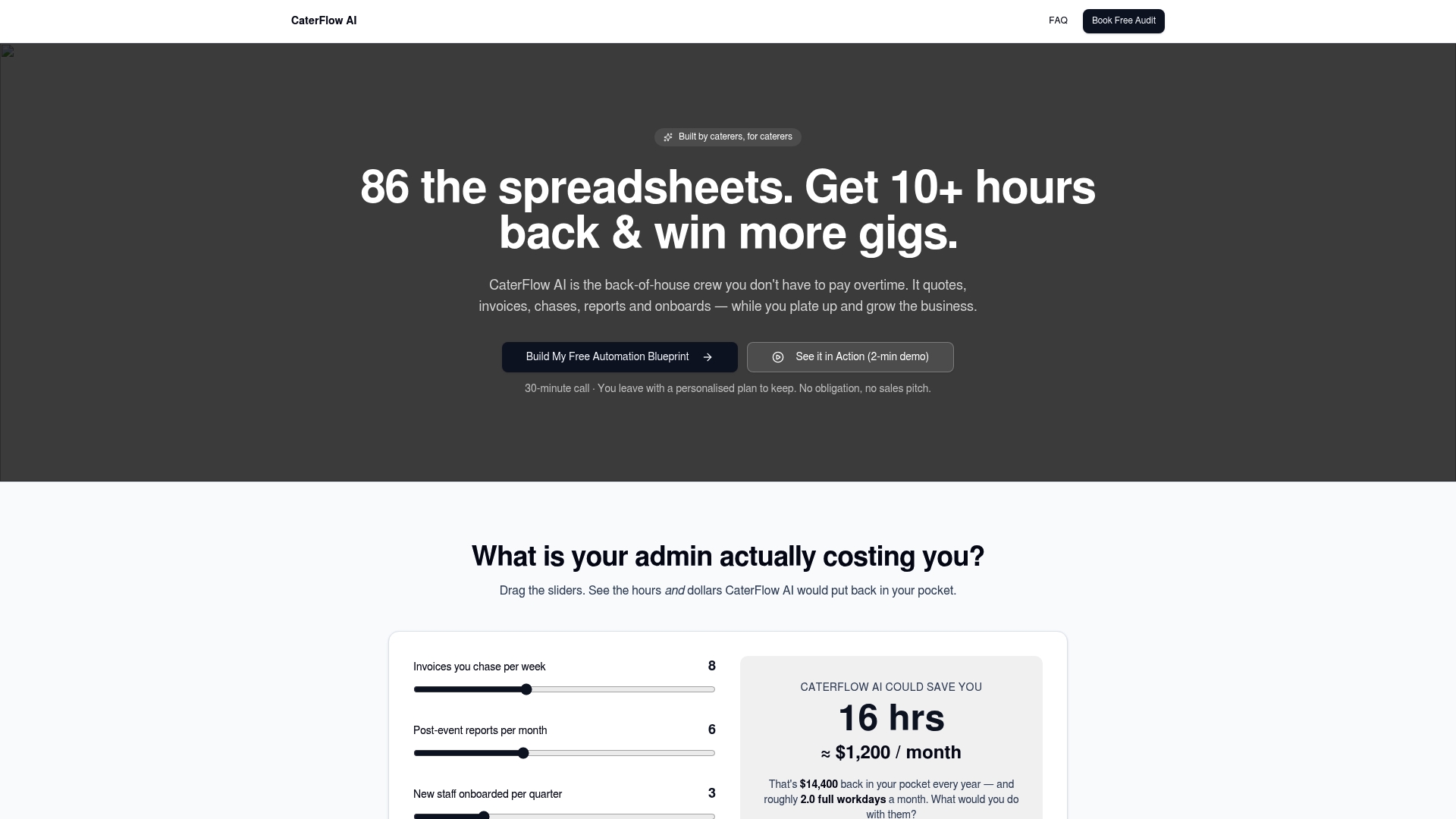
CaterFlow AI automates the parts of cancellation management that eat your evenings: payment reminders that go out the moment a deadline passes, invoice adjustments generated automatically when a booking changes, and a clean record of every refund without a spreadsheet to maintain. Catering businesses using it report recovering meaningful sums from overdue invoices and saving hours of administration every week, time better spent on the next booking than on chasing the last one. If cancellations and payment follow-up are eating into your week, see how CaterFlow AI handles it and check whether it fits your operation.
Sources
- Cancellation Policy | CaterKin
- Refund Policy - Nosh Catering
- REFUND POLICY | ozzies-catering
- Refund & Cancellation Policy - The BBQ Catering Company